
The Madaxeman
Madaxeman.com's Home Page
  • Home
  • Latest Posts
  • Links Page
  • Battle Reports
  • ADLG Index
  • ADLG Wiki
  • Malifaux
  • C London Club
  • 15mm Gallery
  • 15mm Suppliers
  • Facebook
  • The Podcast
  • 10mm
  • Consent Preferences
 RSS Feed

Madaxemans 10mm & Real World Photo Gallery

Photos from museums, and from my 10mm wargaming collection

  • Home
  • Login
  • Album list
    • Last uploads
    • Last comments
    • Most viewed
    • Top rated
    • By date
    • My Favorites
  • Search

The 10mm & Real World Museums Photo Directory - helping you choose the best 10mm tanks, or dig out real cammo schemes from tanks and other military vehicles in museums and shows around the world. You can also search the directory by manufacturer, army or keyword

Anyone can rate the photos just by clicking on the stars beneath each photo. Ratings use a scale of 0-5 where 5 = excellent and 0 = terrible.

Home > Museums and Shows

Most viewed - Museums and Shows
IMGP0618.JPG
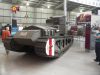
WW1 British tanks124 viewsThe Mark I entered service in August 1916, and was first used in action on the morning of 15 September 1916 during the Battle of Flers-Courcelette, part of the Somme Offensive. With the exception of the few interim Mark II and Mark III tanks, it was followed by the largely similar Mark IV, which first saw combat in June 1917. The Mark IV was used en masse at the Battle of Cambrai in November 1917 The Mark V, with its much improved transmission, entered service in mid-1918.
IMGP0619.JPG
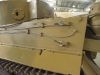
WW1 British tanks124 viewsThe Mark I was a rhomboid vehicle with a low centre of gravity and long track length, able to negotiate broken ground and cross trenches. Main armament was carried in sponsons on the hull sides. The hull was undivided internally; the crew shared the same space as the engine.
PICT1718.JPG
Armoured cars in Delhi124 viewsRead about them on a dedicated CRossley site
PICT1722.JPG
Carden Lloyd Mk IV124 viewsThe Carden Loyd tankettes were a series of British pre-World War II tankettes, the most successful of which was the Mark VI, the only version built in significant numbers. It became a classic tankette design worldwide, was license-built by several countries and became the basis of several designs produced in several different countries.
PICT1761.JPG
The Tiger I124 viewsFrom a 30 degree angle the Tiger's 88mm gun was capable of penetrating the front glacis plate of an American M4 Sherman between 1,800 and 2,100 m (1.1 and 1.3 mi), the British Churchill IV between 1,100 and 1,700 m (0.68 and 1.1 mi), the Soviet T-34 between 800 and 1,400 m (0.50 and 0.87 mi), and the Soviet IS-2 between 100 and 300 m (0.062 and 0.19 mi)
PICT1760.JPG
The Tiger I124 viewsMany modifications were introduced during the production run to improve automotive performance, firepower and protection. Simplification of the design was implemented, along with adjustments for shortages. In 1942 alone, at least six revisions were made, starting with the removal of the Vorpanzer (frontal armour shield) from the pre-production models in April. In May, mudguards bolted onto the side of the pre-production run were added, while removable mudguards saw full incorporation in September.
PICT1762.JPG
Matilda II124 viewsThe tank's suspension system was that which had been developed by Vickers for their Medium C prototype in the mid-1920s.[22] The tank was carried by five double wheel bogies on each side. Four of the bogies were on bellcranks in pairs with a common horizontal coil spring. The fifth, rearmost, bogie was sprung against a hull bracket. Between the first bogie and the idler wheel was a larger diameter vertically sprung "jockey wheel"
PICT1783.JPG
Panther124 viewsThe Panther was a direct response to the Soviet T-34 and KV-1 tanks. First encountered on 23 June 1941, the T-34 outclassed the existing Panzer III and IV At the insistence of General Heinz Guderian, a special Panzerkommision was dispatched to the Eastern Front to assess the T-34 mong the features of the Soviet tank considered most significant were the sloping armor, which gave much improved shot deflection and also increased the effective armor thickness against penetration, the wide track, which improved
PICT1787.JPG
DD Sherman124 viewsDD or Duplex Drive tanks, nicknamed "Donald Duck tanks", were a type of amphibious swimming tank developed by the British during the Second World War. The phrase is mostly used for the Duplex Drive variant of the M4 Sherman medium tank, that was used by the Western Allies during and after the Normandy Landings in June 1944.
IMGP5033.JPG
124 views
2197 files on 220 page(s) 1 - 111 112 113 114 115 116 117 118 119 120 - 220


Visit Madaxeman on

Youtube Logo
Blogger Logo
Facebook Logo
Podbean Logo
Twitter Logo
Spotify Logo
Pinterest Logo
iTunes Logo
Tune In Logo

Podcasts to download from Madaxeman.com

(Also available on Podbean, iTunes and Spotify)


(These are "affiliate links". If you buy something after clicking on them I get a small kickback from eBay)

Page Loads for the 10mm & Museums Gallery:

About This Site & Privacy Information

Powered by Coppermine Photo Gallery