
The Madaxeman
Madaxeman.com's Home Page
  • Home
  • Latest Posts
  • Links Page
  • Battle Reports
  • ADLG Index
  • ADLG Wiki
  • Malifaux
  • C London Club
  • 15mm Gallery
  • 15mm Suppliers
  • Facebook
  • The Podcast
  • 10mm
  • Consent Preferences
 RSS Feed

Madaxemans 10mm & Real World Photo Gallery

Photos from museums, and from my 10mm wargaming collection

  • Home
  • Login
  • Album list
    • Last uploads
    • Last comments
    • Most viewed
    • Top rated
    • By date
    • My Favorites
  • Search

The 10mm & Real World Museums Photo Directory - helping you choose the best 10mm tanks, or dig out real cammo schemes from tanks and other military vehicles in museums and shows around the world. You can also search the directory by manufacturer, army or keyword

Anyone can rate the photos just by clicking on the stars beneath each photo. Ratings use a scale of 0-5 where 5 = excellent and 0 = terrible.

Home > Museums and Shows > Bovington

Most viewed - Bovington
PICT1844.JPG
BRDM 2 117 viewsThe BRDM-2 literally "Combat Reconnaissance/Patrol Vehicle" †[4]) is an amphibious armoured patrol car used by Russia and the former Soviet Union. It was also known under designations BTR-40PB, BTR-40P-2 and GAZ 41-08. This vehicle, like many other Soviet designs, has been exported extensively and is in use in at least 38 countries.
PICT1721.JPG
Viskers advert interwar period116 views
PICT1736.JPG
Mk IV A13 Mk II116 viewsThe A13 MkII, Cruiser Tank Mk IV, had a maximum armour thickness of 30 mm, and faceted armour was mounted on the original turret's sides and rear. This gave the tank a far more modern appearance. Some Mk III tanks were re-built to Mk IV standard while at the factory.
PICT1734.JPG
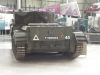
Mk VI116 viewsThe Tank, Light, Mk VI was a British light tank, produced by Vickers-Armstrongs in the late 1930s, which saw service during World War II. The Tank, Light, Mk VI was the sixth in the line of light tanks built by Vickers-Armstrongs for the British Army during the interwar period. The company had achieved a degree of standardization with their previous five models, and the Mark VI was identical in all but a few respects
PICT1757.JPG
Matilda II116 viewsWhile the Matilda possessed a degree of protection that was then unmatched in the North African theatre, the sheer weight of the armour mounted on the vehicle contributed to a very low average speed of about 6 mph (9.7 km/h) on desert terrain. At the time, this was not thought to be a problem since British infantry tank doctrine prioritized heavy armour and trench-crossing ability over speed and cross-country mobility (which was considered to be characteristic of cruiser tanks such as the Crusader)
PICT1764.JPG
The Tiger I116 viewsThis is the colour to paint hose spades on your 15mm models..
PICT1767.JPG
Lee/Grant116 viewsThe M3 was well armed and armored for the period, but due to design flaws (high silhouette, archaic sponson mounting of the main gun, below-average off-road performance) it was not satisfactory and was withdrawn from front line duty as soon as the M4 Sherman became available in large numbers.
PICT1770.JPG
Matilda II116 viewsIn late 1940, during Operation Compass, Matildas of the British 7th Armoured Division wreaked havoc among the Italian forces in Egypt. The Italians were equipped with L3 tankettes and M11/39 medium tanks, neither of which had any chance against the Matildas. Italian gunners were to discover that the Matildas were impervious to a wide assortment of artillery. Matildas continued to confound the Italians as the British pushed them out of Egypt and entered Libya to take Bardia and Tobruk. Even as late as November 1941, German infantry combat reports show the impotence of ill-equipped infantry against the Matilda
PICT1768.JPG
Lee/Grant116 viewsThe design was unusual because the main weapon — a larger caliber, low-velocity 75 mm gun — was in an offset sponson mounted in the hull with limited traverse. A small turret with a lighter, high-velocity 37 mm gun sat on the tall hull. A small cupola on top of the turret held a machine gun. The use of two main guns was seen on the French Char B, the Soviet T-35, and the Mark I version of the British Churchill tank. In each case, two weapons were mounted to give the tanks adequate capability in firing both anti-personnel high explosive ammunition and armor-piercing ammunition for anti-tank combat
PICT1728.JPG
Vickers Mk E Tank115 viewsThe British Army evaluated the Mark E, but rejected it, apparently due to questions about the reliability of the suspension. Vickers then started advertising the design to all buyers, and soon received a trickle of orders eventually including USSR, Greece, Poland, Bolivia, Siam, Finland, Portugal, China and Bulgaria. A Thai order was placed, but taken over by the British when the war started. Vickers built a total of 153 (the most common figure) Mark E's.
270 files on 27 page(s) 1 - 16 17 18 19 20 21 22 23 24 25 - 27


Visit Madaxeman on

Youtube Logo
Blogger Logo
Facebook Logo
Podbean Logo
Twitter Logo
Spotify Logo
Pinterest Logo
iTunes Logo
Tune In Logo

Podcasts to download from Madaxeman.com

(Also available on Podbean, iTunes and Spotify)


(These are "affiliate links". If you buy something after clicking on them I get a small kickback from eBay)

Page Loads for the 10mm & Museums Gallery:

About This Site & Privacy Information

Powered by Coppermine Photo Gallery