
The Madaxeman
Madaxeman.com's Home Page
  • Home
  • Latest Posts
  • Links Page
  • Battle Reports
  • ADLG Index
  • ADLG Wiki
  • Malifaux
  • C London Club
  • 15mm Gallery
  • 15mm Suppliers
  • Facebook
  • The Podcast
  • 10mm
  • Consent Preferences
 RSS Feed

Madaxemans 10mm & Real World Photo Gallery

Photos from museums, and from my 10mm wargaming collection

  • Home
  • Login
  • Album list
    • Last uploads
    • Last comments
    • Most viewed
    • Top rated
    • By date
    • My Favorites
  • Search

The 10mm & Real World Museums Photo Directory - helping you choose the best 10mm tanks, or dig out real cammo schemes from tanks and other military vehicles in museums and shows around the world. You can also search the directory by manufacturer, army or keyword

Anyone can rate the photos just by clicking on the stars beneath each photo. Ratings use a scale of 0-5 where 5 = excellent and 0 = terrible.

Home > Museums and Shows > Bovington

Most viewed - Bovington
IMGP0592.JPG
SOMUA S35 134 viewsThe SOMUA S35 was a French Cavalry tank of the Second World War. Built from 1936 until 1940 to equip the armoured divisions of the Cavalry, it was for its time a relatively agile medium-weight tank, superior in armour and armament to both its French and foreign competitors, such as the contemporary versions of the German Panzerkampfwagen III. It was constructed from well-sloped, mainly cast, armour sections, that however made it expensive to produce and time-consuming to maintain.
IMGP0591.JPG
The Renault UE Chenillette 134 viewsThe Renault UE Chenillette was a light tracked armoured carrier and prime mover produced by France between 1932 and 1940.
PICT1743.JPG
The Tiger I134 viewsTiger I is the common name of a German heavy tank developed in 1942 and used in World War II. The final official German designation was Panzerkampfwagen VI Tiger Ausf.E, often shortened to Tiger. It was an answer to the unexpectedly impressive Soviet armour encountered in the initial months of the Axis invasion of the Soviet Union, particularly the T-34 and the KV-1.
IMGP0564.JPG
Type 95 Japanese tank133 viewsThe primary armament of the most produced version was a Type 98 37 mm gun with the barrel length of 46.1[3] calibers. It elevated between −15 to +20 degrees. The tank carried two types of 37 mm ammunition, the high-explosive and armor-piercing. For the latter, muzzle velocity was 675–700 m/s, and the armor penetration was 25 mm at a distance of 500 m.
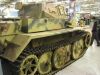
IMGP0572.JPG
PzII Luchs133 viewsThe Lynx was larger than the Ausf. G in most dimensions (length 4.63 m; height 2.21 m; width 2.48 m). It was equipped with a six speed transmission (plus reverse), and could reach a speed of 60 km/h with a range of 290 km. The FuG12 and FuG Spr a radios were installed, while 330 rounds of 20 mm and 2,250 rounds of 7.92 mm ammunition were carried. Total vehicle weight was 11.8 tonnes.
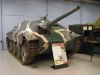
IMGP0587.JPG
Hetzer133 viewsThe Jagdpanzer 38(t) (Sd.Kfz. 138/2), later known as Hetzer ("baiter"), was a German light tank destroyer of the Second World War based on a modified Czechoslovakian Panzer 38(t) chassis. The project was inspired by the Romanian "Mareşal" tank destroyer.
IMGP0595.JPG
Matilda I133 viewsThe Tank, Infantry, Mk I, Matilda I (A11)[1] was a British infantry tank of the Second World War. It is not to be confused with the later model Tank, Infantry Mk II (A12), also known as the "Matilda II" which took over the "Matilda" name after the early part of the war when the first Matilda was withdrawn from combat service. They were of totally different design and did not share components, but did have some similar traits because they were both designed to be infantry tanks, a type of tank that tended to sacrifice speed for increased armour protection.
PICT1774.JPG
T34/85133 viewsAlthough a T-34-85 was still not a match for a Panther, the improved firepower made it much more effective than before. The decision to improve the existing design instead of tooling up for a new one allowed the Soviets to manufacture tanks in such numbers that the difference in capabilities could be considered insignificant.
PICT1850.JPG
Churchill 133 views
IMGP0590.JPG
Tiger II132 viewsThe Tiger II was developed late in the war and built in relatively small numbers - 1,500 Tiger IIs were ordered, but production was severely disrupted by Allied bombing. Among others, five raids between 22 September and 7 October 1944 destroyed 95 percent of the floor area of the Henschel plant. It is estimated that this caused the loss in production of some 657 Tiger IIs. Only 492 units were produced: one in 1943, 379 in 1944, and 112 in 1945. Full production ran from mid-1944 to the end of the war
270 files on 27 page(s) 1 - 7 8 9 10 11 12 13 14 15 16 - 27


Visit Madaxeman on

Youtube Logo
Blogger Logo
Facebook Logo
Podbean Logo
Twitter Logo
Spotify Logo
Pinterest Logo
iTunes Logo
Tune In Logo

Podcasts to download from Madaxeman.com

(Also available on Podbean, iTunes and Spotify)


(These are "affiliate links". If you buy something after clicking on them I get a small kickback from eBay)

Page Loads for the 10mm & Museums Gallery:

About This Site & Privacy Information

Powered by Coppermine Photo Gallery